
Is there a minimum bending radius for aluminium?
In our industry, few things are as strict as the minimum bending radius for aluminium profiles.
Generally aluminium is an incredibly flexible material, not just in bending but also in manufacturing and surface treatment options. It can be very forgiving when compared to other metals, however, it is still limited to how tightly it can be bent before damage is caused.
What influences the bending radius of aluminium?
A wide variety of factors affect the bending radius of aluminium profiles. Both design factors as well as environmental can greatly influence the limits that each profile has. Some of these factors include:
- Material Alloy
- Material Temper
- Material Thickness
- Round / Curved Corners
- Symmetry / Asymmetry of the Profile
- Complexity of the Profile
- Bending Method
- Tooling Material
- Temperature of the Workshop
Adjusting these factors can have a large impact on the eventual bending capabilities of the section. For instance, a very wide section bent on its flat side (the hard way) is normally very prone to twisting. Specially designed tooling can mitigate this, and along with intelligent CNC programming, the twisting can be outright prevented. Many of the factors listed above have specific workarounds similar to this — it’s when these factors are combined that parts become truly difficult to bend.
Mullion sections are notorious in this regard. Twisting, cracking, or rippling are all very real risks faced when bending these sections. It takes a careful balance of methods to bend these sections to tolerance. In this area, our expertise and track record speak for themselves.

Tight bends on aluminium window profiles
Probably the most common industry to have troublesome tight bends is the aluminium window and door industry. These profiles are often very complex and more often than not asymmetrical. Add in the thermal break as another obstacle to smooth bending and you have a recipe for disaster.
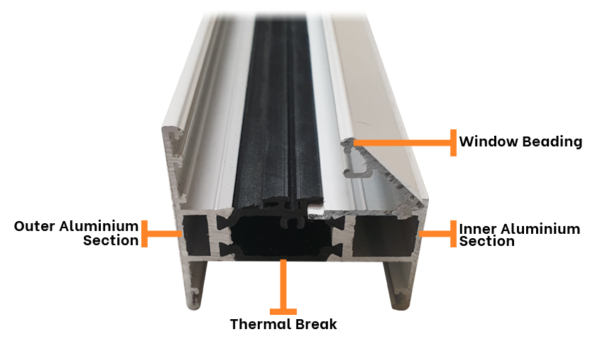
This is why tight bends for aluminium window profiles is one of the key indicators of a top-tier bending service. Ensuring the profile is free of cracks, tears, or ripples while also ensuring the tracks and thermal break remain clear and functional is of utmost importance when bending these sections.
What is the minimum bending radius for aluminium profiles?
Now that we know what influences the minimum bending radius of a profile, just how tight can an aluminium section be formed?
Our lead estimator had this to say about our process:
Minimum bend radii is worked out on a factor rating of how difficult the bend is.
Therefore depending upon the width of the profile multiplied by the factor will give you the minimum bend radius.
Also, we must take into consideration the strength of the material and which way you are bending the profile — either the strong axis (known as the hard way) or the weak axis (known as the easy way) — all have a bearing on the factor rating minimum bend radius.
We can exceed the minimum radii by using special processes if tighter radii are necessary.
Our website has a very handy calculator to assist in this calculation. Check it out here.